Artists Formerly Known
All Pueblos
Several hundred years ago, during the times of the great Southwest migrations, communal feasting developed as a means of meet-and-greet for integrating or rejecting newcomers into established villages. That's about the same time large open serving bowls came into existence. Families would prepare their specialty dish and bring it to share at the feast in their own bowls. When the feast was over, they retrieved their bowls and went back home until next time. They found ways to differentiate each family's bowls from the others, making them easy to recognize and retrieve. Those innovations have, in some cases, carried forward almost to today. Some were in the actual construction of the pots while others were in the execution of the decorations on them.
For instance, Nampeyo was known to have added an extra coil to the rims of her pieces, as she was aware of that being a breakage point should the piece actually be put into some kind of use. Today, "use" is not a consideration and rims have consequently become very thin. Nampeyo was also known for decorations that were slightly off balance, not quite direct copies of anything else on the piece.
Florentino Montoya, of San Ildefonso, was known for particular off-balance flourishes in his designs, used today to identify his pieces as he never signed any. He and his wife, Martina Vigil, were making pottery in the late 1800's. It was they who got Maria Martinez started when she was a young girl.
In general, most pieces of pottery made before the early 1950's were unsigned, their creators, for the most part, now unknown. Only a very few potters, ones who had become convinced of the monetary value of their name on the bottom of a piece, signed anything.
Maria Martinez of San Ildefonso was one of the very first, beginning in 1922. That caused a problem as the outside world then came looking for her in particular, as someone they really wanted to do business with. Then, in 1926, she added her husband's name to the signature as he was doing all the decorating for her. That caused another upheaval among the pueblos as the making of pottery was long considered to be "women's work."
Nampeyo, at Hopi, was also getting established as a potter of note around the same time, but she never learned English, never learned to read or write. As Nampeyo went blind and other members of her family began painting for her, some would sign pieces with her name and theirs, as in "Nampeyo Fannie," on a pot made by Nampeyo and painted by her daughter Fannie. Nampeyo's niece Daisy painted some, too, usually signing some version of "Nampeyo Daisy" or "Nampeyo DHN". Nampeyo's daughter, Annie Healing, worked side by side with Nampeyo for years, doing a lot of her decorating, but Annie never signed either name to anything. At this point in time, we know what to look for to attribute the making and decorating of a pot to Nampeyo but with pieces made after about 1920, it's essentially impossible to tell what was done by Nampeyo and what was done by Annie.
As the outside world began to learn of Nampeyo's art and the art being produced by others on the Hopi mesas, some of the traders, dealers and archaeologists who went to Hopi found that most potters had a hard time reading and writing English. They also didn't recognize the English names that had been given to them. Knowing the value of being able to attribute a particularly well-done piece to a particular potter, the dealers and traders began putting effort into getting the potters to develop "hallmarks," icons to use as identifiers. Marcia Rickey, with her "Flying Ant" avatar was one of the first of those. Sadie Adams with her five-petaled flower was another. Others developed over the years include "Frogwoman" (Navasie family), "Featherwoman" (Naha family), "Carried in Beauty" (Preston Duwyenie), "Antelope Woman" (Zella Cheeda) and more. In the early 1950's that developed into more full-scale signatures, although many continued adding family and clan hallmarks, some just adding small indicators of their own (such as: a distinct "Featherwoman" feather with an "S", meaning Sylvia Naha).
The 1950's saw a renaissance in pottery making among virtually all the pueblos, and with that came full signatures almost everywhere, some with hallmarks and some without. And some potters still use only hallmarks...
100 West San Francisco Street, Santa Fe, New Mexico 87501
(505) 986-1234 - www.andreafisherpottery.com - All Rights Reserved
Tesuque Pueblo

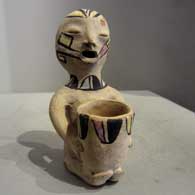
A Tesuque Rain God
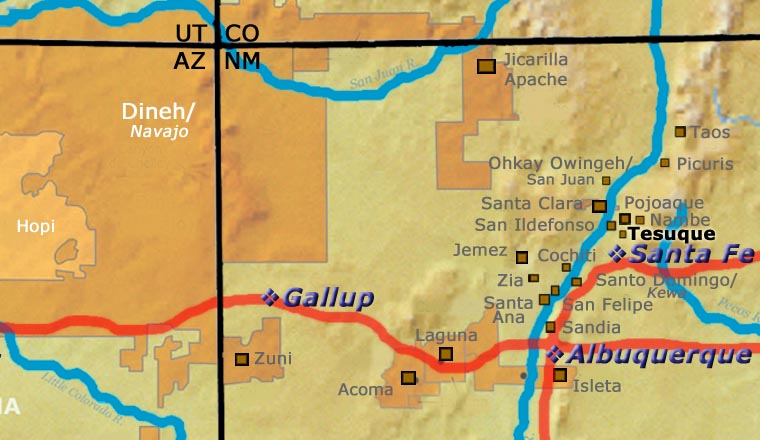
Tesuque Pueblo is located about 10 miles north of today's city of Santa Fe, New Mexico. Archaeologists have dated a few sites in the Tesuque Valley back to Tanoan times, around 850 CE. By 1200 CE there were many small villages in the Tesuque Valley and Santa Fe Basin areas. Then came the Tewa migrations of the late 1200s and early 1300s and everyone started to gather together in larger villages. When the Spanish arrived in 1540, they found only six villages. The main Tesuque Pueblo (at that time) was located about 3 miles east of where today's pueblo is.
During the Pueblo Revolt of 1680, it was a pair of Tesuque runners who misled the Spanish as to when the tribes planned to revolt. The Spanish governor killed the runners for their efforts, then saw many of his Spanish subjects killed when it turned out the "date" was wrong and the tribes revolted early. At Tesuque, the warriors killed the local priest and another government official immediately, then marched to the Palace of the Governors in Santa Fe to join with the warriors of other pueblos in that confrontation with the Spanish. A few days later, the Spanish were allowed to leave the Palace of the Governors peacefully and begin the long march south on the Camino Real, back to Mexico.
When Don Diego de Vargas returned at the head of Spanish troops (the Conquistadors) in 1692 and began to reconquer northern Nuevo Mexico, one of the first things his troops did was burn and tear down the main Tesuque village. Shortly after that the tribe officially submitted to Spanish rule, moved to the present pueblo site and began rebuilding in 1694.
Between changes of government, European-introduced diseases, European encroachment on pueblo land and general disregard for the people of the pueblos, the next 250 years were not kind to the Tesuque people. By 1910, the pueblo's population was down to 77.
Today there are about 800 members of the Tesuque tribe living on a reservation of more than 17,000 acres. The tribe operates the Tesuque Casino and Hotel, and the Camel Rock Suites (on South St. Francis Drive in Santa Fe).
Before the 1800s, Tesuque pottery mostly resembled the pottery produced at San Ildefonso at that time. Around 1830 that began to change as Tesuque potters experimented with newly found clays and slips that shortly made Tesuque Polychrome a style of its own. That style was quite popular until an Anglo trader named Jake Gold appeared. Tesuque potters had long been making small figures they called Muna. Gold convinced most of them to make as many muna as they could, except he called them "Rain Gods." He also convinced them to paint those figurines with commercial paint. Gold did an outstanding marketing job and soon, Tesuque potters were turning out Rain Gods by the thousands. They were distributed nation wide and many manufacturers bought them by the barrel to give away as promotional items with their products. That push for mass production virtually destroyed pottery making at Tesuque. In the 1920s the demand for Rain Gods diminished and the potters turned to making other low quality goods painted with commercial "Day-Glo" poster paints.
In the 1930s and 1940s only a handful of Tesuque potters were producing but Catherine Vigil persevered through those times making traditional Tesuque polychrome pottery. In the 1960s a few young potters took up where Catherine left off and a small revival of traditional pottery making began at Tesuque. There are still some muna trickling into the marketplace, too. However, the tribe's commercial ventures these days have pretty much replaced most making of pottery.
100 West San Francisco Street, Santa Fe, New Mexico 87501
(505) 986-1234 - www.andreafisherpottery.com - All Rights Reserved