
Artists Formerly Known
All Pueblos
Several hundred years ago, during the times of the great Southwest migrations, communal feasting developed as a means of meet-and-greet for integrating or rejecting newcomers into established villages. That's about the same time large open serving bowls came into existence. Families would prepare their specialty dish and bring it to share at the feast in their own bowls. When the feast was over, they retrieved their bowls and went back home until next time. They found ways to differentiate each family's bowls from the others, making them easy to recognize and retrieve. Those innovations have, in some cases, carried forward almost to today. Some were in the actual construction of the pots while others were in the execution of the decorations on them.
For instance, Nampeyo was known to have added an extra coil to the rims of her pieces, as she was aware of that being a breakage point should the piece actually be put into some kind of use. Today, "use" is not a consideration and rims have consequently become very thin. Nampeyo was also known for decorations that were slightly off balance, not quite direct copies of anything else on the piece.
Florentino Montoya, of San Ildefonso, was known for particular off-balance flourishes in his designs, used today to identify his pieces as he never signed any. He and his wife, Martina Vigil, were making pottery in the late 1800's. It was they who got Maria Martinez started when she was a young girl.
In general, most pieces of pottery made before the early 1950's were unsigned, their creators, for the most part, now unknown. Only a very few potters, ones who had become convinced of the monetary value of their name on the bottom of a piece, signed anything.
Maria Martinez of San Ildefonso was one of the very first, beginning in 1922. That caused a problem as the outside world then came looking for her in particular, as someone they really wanted to do business with. Then, in 1926, she added her husband's name to the signature as he was doing all the decorating for her. That caused another upheaval among the pueblos as the making of pottery was long considered to be "women's work."
Nampeyo, at Hopi, was also getting established as a potter of note around the same time, but she never learned English, never learned to read or write. As Nampeyo went blind and other members of her family began painting for her, some would sign pieces with her name and theirs, as in "Nampeyo Fannie," on a pot made by Nampeyo and painted by her daughter Fannie. Nampeyo's niece Daisy painted some, too, usually signing some version of "Nampeyo Daisy" or "Nampeyo DHN". Nampeyo's daughter, Annie Healing, worked side by side with Nampeyo for years, doing a lot of her decorating, but Annie never signed either name to anything. At this point in time, we know what to look for to attribute the making and decorating of a pot to Nampeyo but with pieces made after about 1920, it's essentially impossible to tell what was done by Nampeyo and what was done by Annie.
As the outside world began to learn of Nampeyo's art and the art being produced by others on the Hopi mesas, some of the traders, dealers and archaeologists who went to Hopi found that most potters had a hard time reading and writing English. They also didn't recognize the English names that had been given to them. Knowing the value of being able to attribute a particularly well-done piece to a particular potter, the dealers and traders began putting effort into getting the potters to develop "hallmarks," icons to use as identifiers. Marcia Rickey, with her "Flying Ant" avatar was one of the first of those. Sadie Adams with her five-petaled flower was another. Others developed over the years include "Frogwoman" (Navasie family), "Featherwoman" (Naha family), "Carried in Beauty" (Preston Duwyenie), "Antelope Woman" (Zella Cheeda) and more. In the early 1950's that developed into more full-scale signatures, although many continued adding family and clan hallmarks, some just adding small indicators of their own (such as: a distinct "Featherwoman" feather with an "S", meaning Sylvia Naha).
The 1950's saw a renaissance in pottery making among virtually all the pueblos, and with that came full signatures almost everywhere, some with hallmarks and some without. And some potters still use only hallmarks...
100 West San Francisco Street, Santa Fe, New Mexico 87501
(505) 986-1234 - www.andreafisherpottery.com - All Rights Reserved
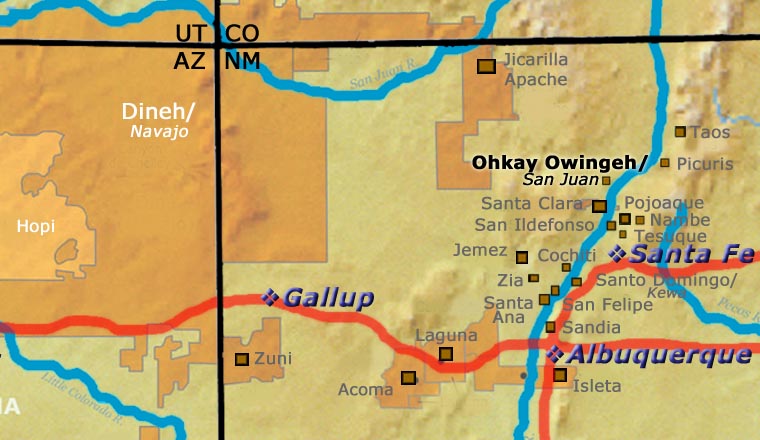
Ohkay Owingeh (San Juan)
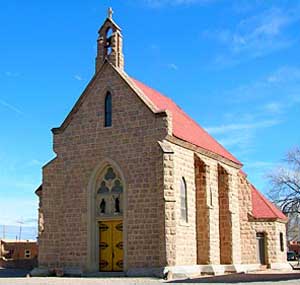
Ohkay Owingeh Mission
Ohkay Owingeh has a long history of pottery-making. Archaeologists even date certain timespans in the Pueblo II era by the San Juan Polychrome and San Juan Blackware potsherds that have been found in many digs. The styles were so striking for the time that archaeologists have been able to reconstruct trade routes by the date of appearance of those styles in different pueblos. But the making of pottery in the traditional way is not so widespread at Ohkay Owingeh these days.
In 2005 San Juan Pueblo officially changed its name back to the original name (before the Spanish arrived): Ohkay Owingeh (meaning: Place of the strong people). There are numerous abandoned ancient pueblos in the countryside around today's primary village of Ohkay Owingeh that have been archaeologically excavated and dated, but none of those excavations have yielded a date for the establishment of the village on the east side of the Rio Grande that was discovered by Don Juan de Oñaté in 1597.
The people of Ohkay Owingeh speak Tewa, and may have come to the Rio Grande area from southwestern Colorado or from the San Luis Valley in central Colorado. There is an archaeological record that possibly tracks their ancestors as they moved downstream through the valleys of the Ojo Caliente and Chama Rivers to the Rio Grande in the 1300 and 1400s. There is also an archaeological history showing there were Tanoan groups living in the area for hundreds of years before that.
Spanish conquistador Don Juan de Oñate took control of Ohkay Owingeh in 1598, renaming it San Juan de los Caballeros (after his patron saint, John the Baptist). He established the first Spanish capitol of Nuevo Mexico across the Rio Grande in the village of Yugue-Yunqué, an area he renamed San Gabriel. In 1608, the capitol was moved south to an uninhabited area that became the Santa Fe we know today.
After 80 years of progressively deteriorating living conditions under the Spanish, the tribe participated in the Pueblo Revolt of 1680 (one of the revolt's ringleaders, Popé, was an Ohkay Owingeh shaman) and helped to expel the Spanish from Nuevo Mexico for 12 years. However, when the Spanish returned in 1692, Popé had died, that tribal unity had collapsed and the individual pueblos were relatively easy for the Spanish to reconquer.
Today, Ohkay Owingeh is the largest Tewa-speaking pueblo (in population and land) but few of the younger generations are interested in carrying on with many of the tribe's traditional arts and crafts (such as the making of pottery, weaving of baskets and knapping of flint). The pueblo is home to the Eight Northern Indian Pueblos Council, the Oke-Oweenge Arts Cooperative, the San Juan Lakes Recreation Area and the Ohkay Casino & Resort. The tribe's Tsay Corporation is one of northern New Mexico's largest private employers. With the tribe's modern foray into casino operations, the younger members of the tribe say it's much easier to make a living flipping burgers, dealing cards or working security jobs than pursuing the production of traditional arts and crafts. This has become a problem everywhere there are Indian casinos, no matter who the tribe is.
100 West San Francisco Street, Santa Fe, New Mexico 87501
(505) 986-1234 - www.andreafisherpottery.com - All Rights Reserved
