
Janee Baca
1919-2011
Santa Clara
Jane Baca was the daughter of Herman and Marianita Chavarria Velarde. Potter Legoria Tafoya and painter Pablita Velarde were her sisters.
Jane was an active potter in the mid-1930s, making carved and polished brownware and blackware engagement baskets, wedding vases, bowls, and beaver, bear and human figures. Her favorite designs were beavers, bears, kiva steps and the avanyu (the mythic Tewa water serpent).
Jane's daughter, (Pamela) Starr Tafoya, was born in 1951 and grew up watching and working with her mother while she made pottery. Collaborations between the two (signed Jane & Starr) won the First, Second and Third Place ribbons for plain Santa Clara pottery at the 1981 Santa Fe Indian Market. Both won many more ribbons after that.
Jane and Starr exhibited at the Santa Fe Indian Market for more than 20 years. They were also participants at the Eight Northern Pueblos Arts & Crafts Show for more than 10 years.
Some of the Awards won by Jane
- 2001 Santa Fe Indian Market. Classification II - Pottery, Division C - traditional pottery, carved or incised, Category 1004 - figure, single or multiple: Second Place with Starr Tafoya
- Division B - traditional pottery, undecorated, Category 905 - figures (single or multiple): Second Place with Starr Tafoya - 2000 Santa Fe Indian Market. Classification II - Pottery. Division B- traditional pottery, undecorated, plain, polished. Category 907-Figurine: Second Place and Third Place with Starr Tafoya
- 1999 Santa Fe Indian Market. Pottery, Category 1406 - figures up to 7": Second Place
- Category 1408 - figures: First Place - 1997 Santa Fe Indian Market. Classification II - Pottery, Division B - Traditional pottery, Category 907 - Figures: First Place and Second Place
- 1996 Santa Fe Indian Market. Classification II - Pottery, Division B - Traditional pottery, Category 907 - Figures: Third Place with Starr Tafoya
- 1993 Santa Fe Indian Market. Category 907 - Figures: Second Place
- 1992 Santa Fe Indian Market. Category 907 - Figures: First Place
- 1990 Santa Fe Indian Market. Division B: traditional pottery, Category 807: Second Place
- 1984 Santa Fe Indian Market. Category 807: First Place
- 1981 Santa Fe Indian Market. First Place (Bear), Second Place (Canteen), Third Place (Miniature bears)
100 West San Francisco Street, Santa Fe, New Mexico 87501
(505) 986-1234 - www.andreafisherpottery.com - All Rights Reserved

Santa Clara Pueblo
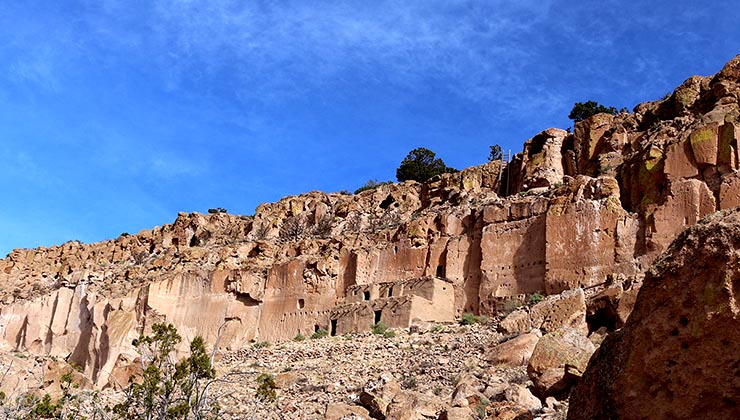
Abandoned Dwellings at Puye Cliffs, Santa Clara Pueblo
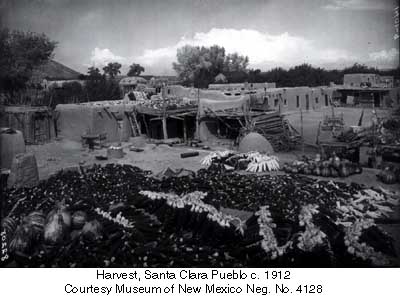
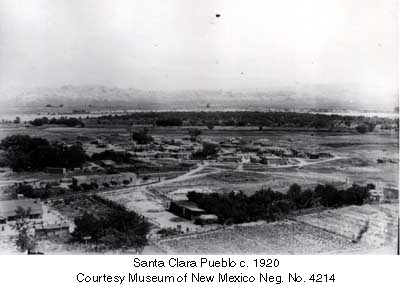
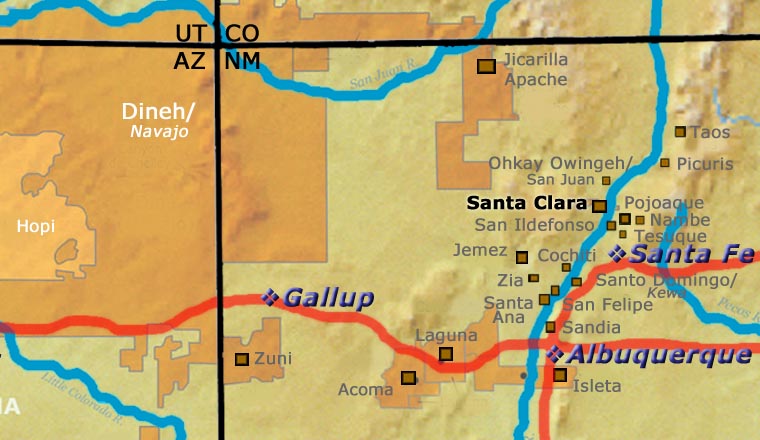
Santa Clara Pueblo straddles the Rio Grande about 25 miles north of Santa Fe. Of all the pueblos, Santa Clara has the largest number of potters.
The ancestral roots of the Santa Clara people have been traced to ancient pueblos in the Mesa Verde region in southwestern Colorado. When that area began to get dry between about 1100 and 1300 CE, some of the people migrated eastward, then south into the Chama River Valley where they constructed several pueblos over the years. One was Poshuouinge, built about 3 miles south of what is now Abiquiu on the edge of the Jemez foothills above the Chama River. Eventually reaching two and three stories high, and with up to 700 rooms on the ground floor, Poshuouinge was occupied from about 1375 CE to about 1475. Drought then again forced the people to move, some of them going to the area of Puye (on the eastern slopes of the Pajarito Plateau of the Jemez Mountains) and others downstream to Ohkay Owingeh (San Juan Pueblo, along the Rio Grande). Beginning around 1580 CE, drought forced the residents of the Puye area to relocate closer to the Rio Grande and they founded what we now know as Santa Clara Pueblo on the west bank of the river, with San Juan Pueblo to the north and San Ildefonso Pueblo to the south.
In 1598 the seat of Spanish government was established at Yunque, near San Juan Pueblo. The Spanish proceeded to antagonize the Puebloans so badly that that government was moved to Santa Fe in 1610, for their own safety.
Spanish colonists brought the first missionaries to Santa Clara in 1598. Among the many things they forced on the people, those missionaries forced the construction of the first mission church around 1622. However, like the other pueblos, the Santa Clarans chafed under the weight of Spanish rule. As a result, they were in the forefront of the Pueblo Revolt of 1680. One Santa Clara resident, a mixed black and Tewa man named Domingo Naranjo, was one of the rebellion's ringleaders. However, the pueblo unity that allowed them to chase the Spanish out fell apart shortly after their success, especially after Popé died.
When Don Diego de Vargas came back to the area in 1694, he found most of the Santa Clarans on top of nearby Black Mesa (with the people of San Ildefonso). A six-month siege didn't subdue them so finally, the two sides negotiated a treaty and the people returned to their pueblos. However, successive invasions and occupations by northern Europeans took their toll on all the tribes over the next 250 years. Then the swine flu pandemic in 1918 almost wiped them out.
Today, Santa Clara Pueblo is home to as many as 2,600 people and they comprise probably the largest per capita number of artists of any North American tribe (estimates of the number of potters run as high as 1-in-4 residents).
Today's pottery from Santa Clara is typically either black or red. It is usually highly polished and designs might be deeply carved or etched ("sgraffito") into the pot's surface. The water serpent, (avanyu), is a very common traditional design motif on Santa Clara pottery. Another motif comes from the legend that a bear helped the people find water during a drought. The bear paw has appeared on much of their pottery ever since.
Santa Clara has received a lot of distinction because of the evolving artistry the potters have brought to their craft. Not only did this pueblo produce excellent black and redware, several notable innovations helped move pottery from the realm of utilitarian vessels into the domain of art. Different styles of polychrome redware emerged in the 1920s-1930s. In the early 1960s experiments with stone inlay, incising and double firing began. Modern potters have also extended the tradition with unusual shapes, slips and designs, illustrating what one Santa Clara potter said: "At Santa Clara, being non-traditional is the tradition." (This refers strictly to artistic expression; the method of creating pottery remains traditional).
Santa Clara Pueblo is home to a number of famous pottery families: Tafoya, Baca, Gutierrez, Naranjo, Suazo, Chavarria, Garcia, Vigil, and Tapia - to name a few.
100 West San Francisco Street, Santa Fe, New Mexico 87501
(505) 986-1234 - www.andreafisherpottery.com - All Rights Reserved
Marianita Velarde Family Tree
Disclaimer: This "family tree" is a best effort on our part to determine who the potters are in this family and arrange them in a generational order. The general information available is questionable so we have tried to show each of these diagrams to living members of each family to get their input and approval, too. This diagram is subject to change should we get better info.
- Marianita Chavarria Velarde & Herman Velarde
- Jane Baca
- Kathy Tafoya
- Pamela Starr Tafoya
- Velma Tafoya
- Legoria Velarde (1911-1984) & Pasqual Tafoya
- Celes Velarde Tafoya & Jose Miguel Tafoya
- Evelyn Tafoya Aguilar & Lorenzo Aguilar
- Joyce Tafoya Browning
- Crystal Tafoya
- Emily C. Tafoya
- Gladys A. Tafoya
- Michael A. Tafoya
- Emilio Tafoya
- Sue Tafoya
- Celes Velarde Tafoya & Jose Miguel Tafoya
- Pablita Velarde (painter, pottery painter)
- Helen Hardin (1943-1984)
Some of the above info is drawn from Pueblo Indian Pottery, 750 Artist Biographies, by Gregory Schaaf, © 2000, Center for Indigenous Arts & Studies
Other info is derived from personal contacts with family members and through interminable searches of the Internet.
(505) 986-1234 - www.andreafisherpottery.com - All Rights Reserved